
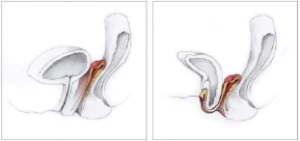
Pelvic organ prolapse is when 1 or more of the organs in the pelvis slip down from their normal position and bulge into the vagina.
Types of prolapse:
Pelvic organ prolapse symptoms include:
What is the cause of pelvic organ prolapse:
Pelvic organ prolapse happens when the muscles or connective tissues of the pelvis do not work as they should. The most common risk factors are: Vaginal childbirth, which can stretch and strain the pelvic floor. Multiple vaginal childbirths raise your risk for pelvic organ prolapse later in life and hysterectomy.
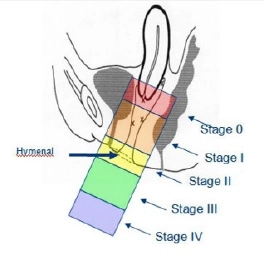
Degrees of uterine prolapse:
At what stage does pelvic organ prolapse need surgery?
Surgery is usually done only when the prolapse is affecting your daily life and your doctor thinks surgery will help. Consider surgery if the prolapse causes pain, if you have problems with your bladder and constipation.
Surgical treatment of pelvic organ prolapse:
For more than 50 years, the gold standard of POP surgery has always been sacrocolpopexy. Today, open surgery has been replaced by laparoscopic or keyhole surgery where the sacrocolpopexy procedure is done through only three 10mm incisions.
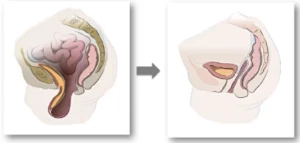
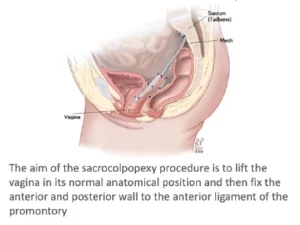
Sacrocolpopexy (sacral colpopexy) is a surgical technique for repairing pelvic organ prolapse. Reconstruction is achieved with a laparoscopic abdominal technique or with the use of robotic minimally invasive techniques. The specific treatment approach is chosen in accordance with the type and degree of pelvic organ prolapse, as well as the severity of symptoms.
The procedure is done through 3 laparoscopic ports into the abdomen. First, the bladder and rectum must be separated from the vagina to create a space to place the mesh. Next, the surgeon places surgical mesh at the top and bottom walls of your vagina. Finally, they attach it to a ligament covering your sacrum. Because your sacrum is higher than your vagina, the mesh acts as a lift. The mesh supports the bladder and acts like a scaffold for the bladder to rest on.
If a patient still has a uterus, it is recommended that a hysterectomy is done at the same time for better mesh placement.
The use of mesh in the abdomen is completely safe and should not be confused by mesh placed through the vagina. The vaginal mesh placement fell out of favour due to high complication rate.
How long does it take to recover from sacrocolpopexy?
Most women feel better within the first week following surgery; however, do not lift, push or pull any heavy objects until 6 weeks after the operation. Full recovery takes six weeks to allow for internal healing, but mild activity can be started as soon as you leave the hospital. Hospitalization is only for 48hrs.
