


A Life on the Line A patient facing rejection from multiple doctors in the United States had run out of options. With a 3.2kg renal tumour, a serious heart condition, and Type 2 diabetes, he was repeatedly told that surgery was too risky. Every consultation ended with the same response: inoperable. But where others saw […]

A Life on the Line
A patient facing rejection from multiple doctors in the United States had run out of options. With a 3.2kg renal tumour, a serious heart condition, and Type 2 diabetes, he was repeatedly told that surgery was too risky. Every consultation ended with the same response: inoperable. But where others saw risk, Dr MC Conradie saw an opportunity to save a life.
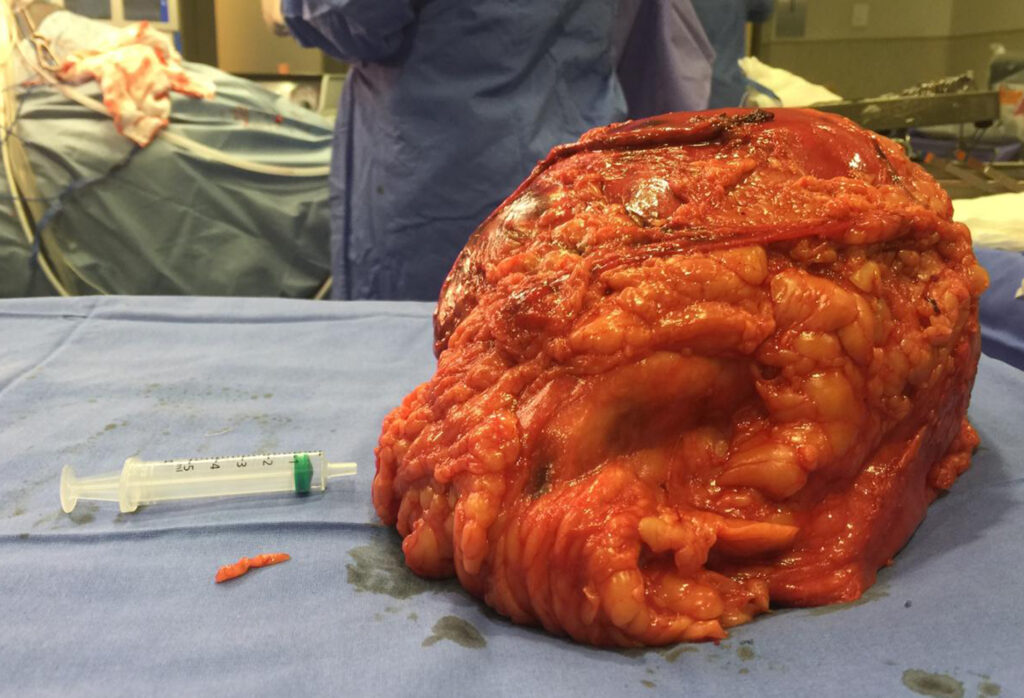
This would go on to become one of the most technically demanding nephrectomies ever attempted — and ultimately a historic one. The renal mass would later be confirmed as the largest ever removed laparoscopically in medical history. Against the odds, a life was saved — not through luck, but through world-class skill, determination, and bold decision-making.
A Misdiagnosis, Luckily Rectified
In the United States, the patient had received several conflicting diagnoses. Some medical teams considered the tumour terminal. Others warned that surgery carried an almost certain risk of death due to his comorbidities: severe cardiac issues and Type 2 diabetes, both of which dramatically increased surgical risks. Though discouraged, the patient refused to accept this as the end.
He began exploring options beyond his borders and eventually found Dr MC Conradie. After a detailed review of his scans and overall condition, Dr Conradie challenged the prior assessments. She believed the tumour could be removed safely — with the right surgical team, careful preoperative planning, and a precise approach. What began as a hopeless case quickly became a second chance at life.
On serial CT scans done in the USA, the tumour in the left kidney increased in size from 6 cm to 29 cm in just over 1 year. This translates to a very aggressive and fast-growing tumour/cancer.

The Complex Risk Profile
This case presented a combination of medical complexities that would deter most surgical teams. The patient carried a 3.2kg renal tumour, a serious cardiac condition, and Type 2 diabetes — all of which placed him at extremely high risk under anaesthesia. The danger of catastrophic bleeding added another layer of difficulty.
Successfully operating on this patient required far more than technical skill. It demanded an experienced multidisciplinary team, expert anaesthetic support, and a comprehensive surgical plan that accounted for every possible complication. The tumour’s sheer size meant that even a laparoscopic approach — Dr Conradie’s area of specialty — would be near impossible. But giving up was never part of the plan.
The Operation: Groundbreaking in Laparoscopic Cancer Surgery
Surgery was performed completely via laparoscopic route, an approach known for its minimal invasiveness and quicker recovery time. But removing a tumour this size presented unique logistical challenges. Once freed, the tumour was extracted through a secondary incision to remove the specimen intact.
Recovery and Outcome
The patient’s recovery was steady and uneventful. Kidney function was preserved, and no extended ICU stay was required beyond planned postoperative monitoring. Emotionally, the experience was transformative. From being told he was out of options to waking up tumour-free, the patient expressed immense gratitude for the care he received. He is now thriving post-surgery, with a new lease on life and renewed confidence in his future.
“It is remarkable, I already feel much better than I have in a long time and my family and I are grateful that we were able to have Dr Conradie undertake this operation at Netcare Waterfall City Hospital,” he said. “You aren’t just another number here and the medical care I have received has been nothing short of world class. Contrary to my experience here, in the United States where I have lived for some 35 years now, I was pushed from pillar to post.”
“The last urologist I saw in the US said to me that he would not undertake an operation on the growth, particularly as I also had heart problems and type 2 diabetes. He told me I was too high-risk a patient and he didn’t want to spoil his outstanding surgical record. In fact he joked that no one would operate on me in the US ‘except perhaps in Hollywood’!”
Reflecting on the Power of Surgical Skill and Second Opinions
Cases like this reaffirm Dr Conradie’s belief in the importance of second opinions — and the power of refusing to give up when faced with complexity. While some cases are high-risk, that doesn’t always mean impossible. Her approach is driven by accuracy in diagnosis, comprehensive evaluation, and a readiness to tackle what others might decline. It also illustrates the importance of recognising individuals that can provide world-class standard of care regardless of geographic setting.
This nephrectomy not only redefined what’s possible in minimally invasive surgery, but it also demonstrated how knowledge, skill, and courage can offer hope where there was once none.
The Takeaway
This is more than a surgical success story. It’s a powerful reminder of how the right expertise, bold leadership, and belief in possibility can save lives — even when the odds seem insurmountable.

